The Contractor's Guide to Getting Paid Faster
Late payments hurt your cash flow and your business. Learn how digital invoicing, online payments, and automated reminders can dramatically reduce your days-to-payment.
Construction invoices routinely get paid weeks after their due date — Levelset's 2022 Construction Cash Flow & Payment Report put the industry's average days sales outstanding near 90, and fewer than 4 in 10 companies said they get paid within 30 days. Part of that delay is the bank's — the other part is invoice design and follow-up discipline. Tighten those two and you can cut your days-to-payment to under 21 days on most jobs, which translates directly into less cash tied up in receivables and less reliance on your line of credit.
Why Customers Pay Slow
It's rarely malice. The four real reasons are: the invoice landed in someone's inbox who isn't the decision-maker; the invoice doesn't make payment frictionless; there's a billing dispute the customer hasn't communicated; and your follow-up cadence is too polite. Fix those four and most of your slow-pay problem disappears.
1. Make Paying Frictionless
If your invoice says "make check payable to..." you've introduced three to seven days of float between when the customer wants to pay and when you receive the money. Every step the customer has to take — find the checkbook, address the envelope, find a stamp, drive to the mailbox — is a step where the invoice gets buried.
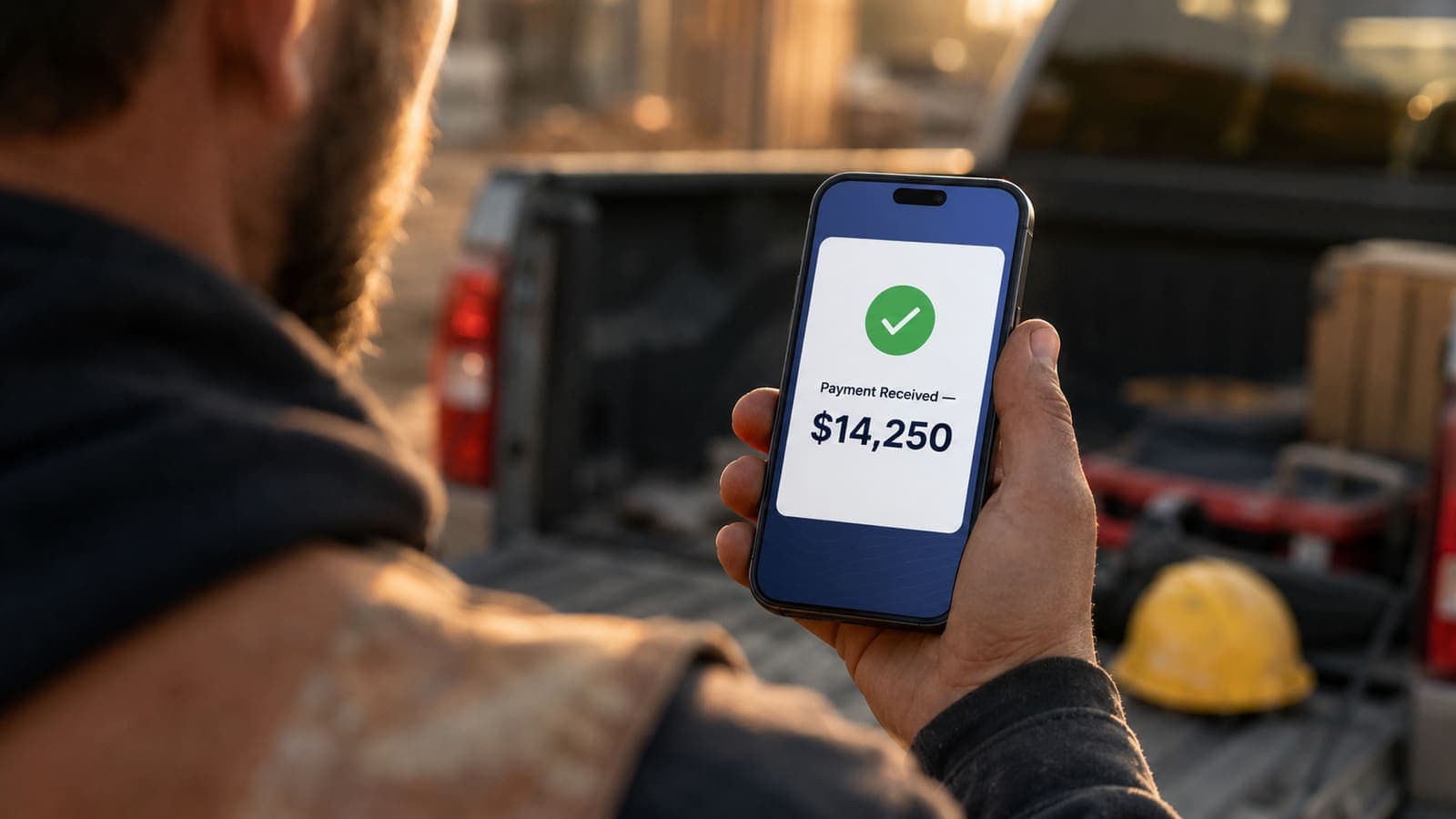
Modern invoices include a one-click pay-now link that accepts ACH, debit, and credit cards. ACH is free or near-free, credit cards are about 2.9% + 30¢ at Stripe's published standard rate but worth offering for customers who want the cash-back rewards. The contractor who accepts cards on a $25,000 invoice eats $725 in processing fees — and gets paid in three hours instead of three weeks. Cash-flow math favors fast payment almost every time.
2. Bill in Milestones, Not at Completion
Lump-sum billing at end of job is a cash flow disaster waiting to happen. You finance the entire job on your line of credit, you have all your exposure at the end when the customer is most likely to nickel-and-dime the punch list, and you have zero touchpoints between contract signing and final invoice.
A typical residential remodel should bill out as: a deposit on signing (where your state allows it — California caps home-improvement deposits at the lesser of 10% or $1,000), roughly a third at rough-in complete, a third at substantial completion, and the balance on punch-list complete. Every milestone is tied to verifiable progress, every milestone keeps cash flowing in, and any dispute happens with 20% of contract value at stake instead of 100%.
3. Send to the Right Person
On commercial jobs, the person who signed the contract is rarely the person who cuts checks. Every invoice should go to the AP contact AND copy the project owner. On residential, send the invoice to both spouses if there are two — one will be more responsive than the other and you have no way of knowing in advance which.
4. Automate the Follow-Up Cadence
Most contractors send the invoice once and then awkwardly call the customer 6 weeks later to ask if they got it. A consistent follow-up cadence — automated by software so you don't have to remember — closes faster than human nagging because it's emotionally neutral and impossible to be embarrassed about.
- Day 0: Invoice sent. Email with one-click pay button.
- Day 7: Friendly "just confirming receipt" email if unpaid. Auto-sent.
- Day 14: Reminder with the same pay link. Auto-sent.
- Day 21: Phone call from the contractor (not automated — this is the human touch).
- Day 30+: Late fee added per contract terms; written notice sent.
In your contract, specify a 1.5% per month late fee on balances over 30 days. You'll rarely have to collect it; the threat itself moves invoices to the top of the pile.
5. Track Aging Religiously
Every Monday morning, look at your aging receivables report sorted by days overdue. Anything over 45 days needs personal contact from you, not from your bookkeeper, not from an automation. The longer an invoice sits, the lower the probability it ever gets paid in full — by 90 days you are negotiating a discount just to close the file.
The Compounding Math
Say you cut average days-to-payment from eight weeks to three: on a steady revenue stream, roughly one month of billing comes off your receivables and back into cash. On a $2M contractor, that's roughly $167K of cash you don't need to borrow against your line of credit, which at a typical 9% LOC rate saves about $15K a year in interest — straight to the bottom line.
FieldsHub invoices ship with one-click online payment, automatic reminder cadences, and milestone billing support out of the box. If you're still mailing PDFs and chasing payments by phone, you're leaving real money on the table every month.
The fee figures above are Stripe’s published US rates — 2.9% + 30¢ per card payment and 0.8% capped at $5 per ACH transfer — which is what FieldsHub passes through with no platform fee on top.
Sources
Ready to put this into practice?
Start a free FieldsHub trial — no credit card required.
Start Free Trial