5 Ways to Reduce Cost Overruns on Construction Projects
Cost overruns are one of the biggest challenges in construction. Learn practical strategies to keep your projects on budget using better tracking, live budgets, and milestone billing.
Cost overruns are the silent margin killers of construction. Double-digit overruns are routine on private projects, and complex jobs run higher still. The arithmetic is brutal: for a contractor running on a 10% net margin, say a 16% overrun on one job doesn’t just erase that job’s profit — it leaves a roughly 6% loss, which eats most of the profit from another healthy job of the same size.
The good news: overruns aren't random. They cluster around the same five root causes on almost every job. Address those five and overruns stop being a surprise and start being a line you manage. Here's how the best-run contracting businesses do it.
1. Build Estimates From Real Cost Data, Not Gut Feel
Most cost overruns are baked in before the project even starts. An optimistic estimate that doesn't reflect actual recent material costs, labor productivity in your local market, or your real overhead burden sets you up to lose money the day the contract is signed.
Move off spreadsheets that store last year's numbers. Use an estimating tool that pulls from your own historical job-cost data and current supplier pricing. The best modern estimating platforms generate three-tier (Good / Better / Best) options in minutes, with margins calculated on real costs instead of guessed-at allowances.
Audit your last 10 completed jobs. Calculate the gap between estimated vs. actual labor hours. If that gap is over 8%, your labor productivity assumptions need to be recalibrated before you bid your next job.
2. Track Costs Live, Not Monthly
A cost overrun discovered at month-end is a cost overrun you can no longer prevent. By the time the accountant flags that materials spending is over budget, the materials are already on the jobsite and the invoices are already due.
Move to live job-cost tracking. Every receipt, every labor entry, every PO should flow into a real-time budget view broken down by phase or cost code. When you can see a phase trending 20% over within the first week of work, you have time to renegotiate, swap materials, or adjust scope — not weeks later when the only choice left is to absorb the loss.
3. Bill in Milestones, Not Lump Sums
Lump-sum billing at completion is a cash flow trap. You finance the entire project on your own credit line, and any overrun comes out of your own pocket before you ever see a dime back from the customer.
Milestone billing solves two problems at once. First, it keeps cash coming in throughout the project, so you're never out-of-pocket on materials. Second — and this is the part most contractors miss — it forces a customer-facing checkpoint at each milestone, which surfaces scope creep and pricing disagreements early instead of letting them compound into a single ugly conversation at the end.
- Tie milestones to verifiable deliverables (rough-in passed inspection, drywall hung and taped, etc.), not just dates.
- Bill a materials deposit up front on long projects, sized to what you must buy before day one — and check your state's cap (California limits home-improvement deposits to the lesser of 10% or $1,000).
- Keep final retainage modest (typically 10%) so you're not financing the punch list for free.
4. Treat Change Orders as a Formal Process
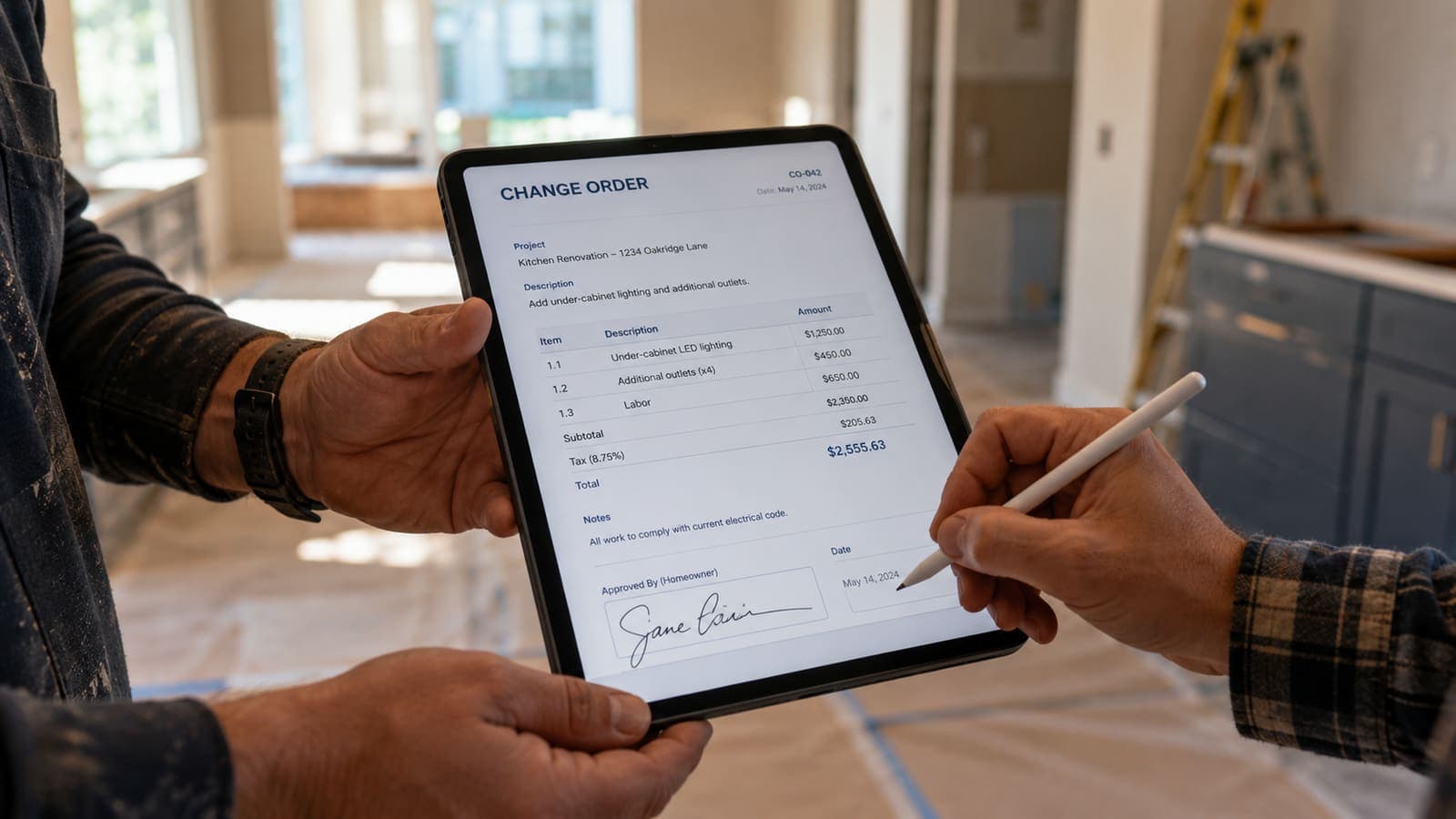
Verbal change orders ("yeah we can just do that") are the single biggest source of contractor disputes — and a hidden driver of overruns. The work gets done, the invoice goes out, the customer disputes it, and either the contractor eats the cost or the relationship ends in a lawyer's office.
Every scope change, no matter how small, needs a written change order with a price and a signature before the work happens. Mobile-friendly digital change orders make this fast enough that crews actually use them — the friction has been the only reason contractors skipped them. With one-tap approval from the customer's phone, the no-paper excuse is gone.
5. Use AI to Surface Risk Before It Becomes Overrun
The newest generation of construction management software analyzes your in-progress job data — labor hours logged, materials consumed vs. estimated, days elapsed, weather delays — and flags projects trending toward overrun while there's still time to correct course.
This isn't magic. The model is just doing what an experienced PM would do if they had the bandwidth to deeply review every project every week: comparing pace-of-spend to pace-of-completion and shouting when they diverge. The difference is the AI shouts before you would have noticed.
The Compounding Effect
None of these five fixes is dramatic on its own. A 1-2% margin improvement from better estimates, plus 1-2% from tighter change-order discipline, plus 1-2% from earlier overrun detection — that's 3-6 points of net margin on top of what you're running today. On a contractor doing $2M a year, that's an extra $60-120K of profit going to the owner instead of evaporating into avoidable overruns.
FieldsHub is built around these five disciplines. AI-generated estimates pulled from your real cost history, live budget tracking with mobile receipt capture, milestone-based invoicing with online customer approval, digital change orders, and photo-documented daily logs — all in one platform. If you're losing more than 5% of revenue to cost overruns, the tools to fix that already exist.
Where the numbers come from: McKinsey Global Institute’s 2017 report Reinventing construction found that large projects typically run 20% longer than scheduled and up to 80% over budget — the pattern this article is trying to keep off small jobs.
Sources
Ready to put this into practice?
Start a free FieldsHub trial — no credit card required.
Start Free Trial