Progress Billing for Small Contractors: Deposits, Payment Schedules and Milestones
How to set a payment schedule that keeps cash ahead of costs on a multi-week job — deposit size, milestone choice, what to do about change orders, and what progress billing is not.
Progress billing is the simple idea that on a job longer than a week or two, the customer pays as the work is delivered instead of all at the end. Done right, your cash never falls behind your costs. Done wrong — a small deposit, one invoice at the end — you are the bank for your customer’s remodel. This guide is for residential and light-commercial contractors; the commercial paperwork (schedules of values, retainage) is covered at the end so you know where the line is.
Start with the deposit
The deposit covers what you have to buy before you can start: materials with lead times, the permit, the first week of labor. Size it to those costs rather than to a percentage you heard once. Check your state’s rules — several states cap home-improvement deposits (California limits them to the lesser of 10% or $1,000, for example), and a schedule that follows the law is one fewer thing to argue about.
Choose milestones the customer can see
A milestone is something you can photograph: demo complete, rough-in passed inspection, drywall hung, tile finished. Tie each draw to one. “50% at midpoint” invites a debate about where the midpoint is; “draw 2 on passed rough inspection” does not. Three to five milestones cover most residential jobs.
Keep cash ahead of cost
Lay the schedule against your cost curve. If the expensive materials land in week three, the draw that pays for them should be due at the end of week two. A simple rule: at every milestone, what the customer has paid should be slightly more than what the job has cost you so far. If the schedule cannot get there, the deposit is too small or there are too few draws.
Change orders go on the next draw
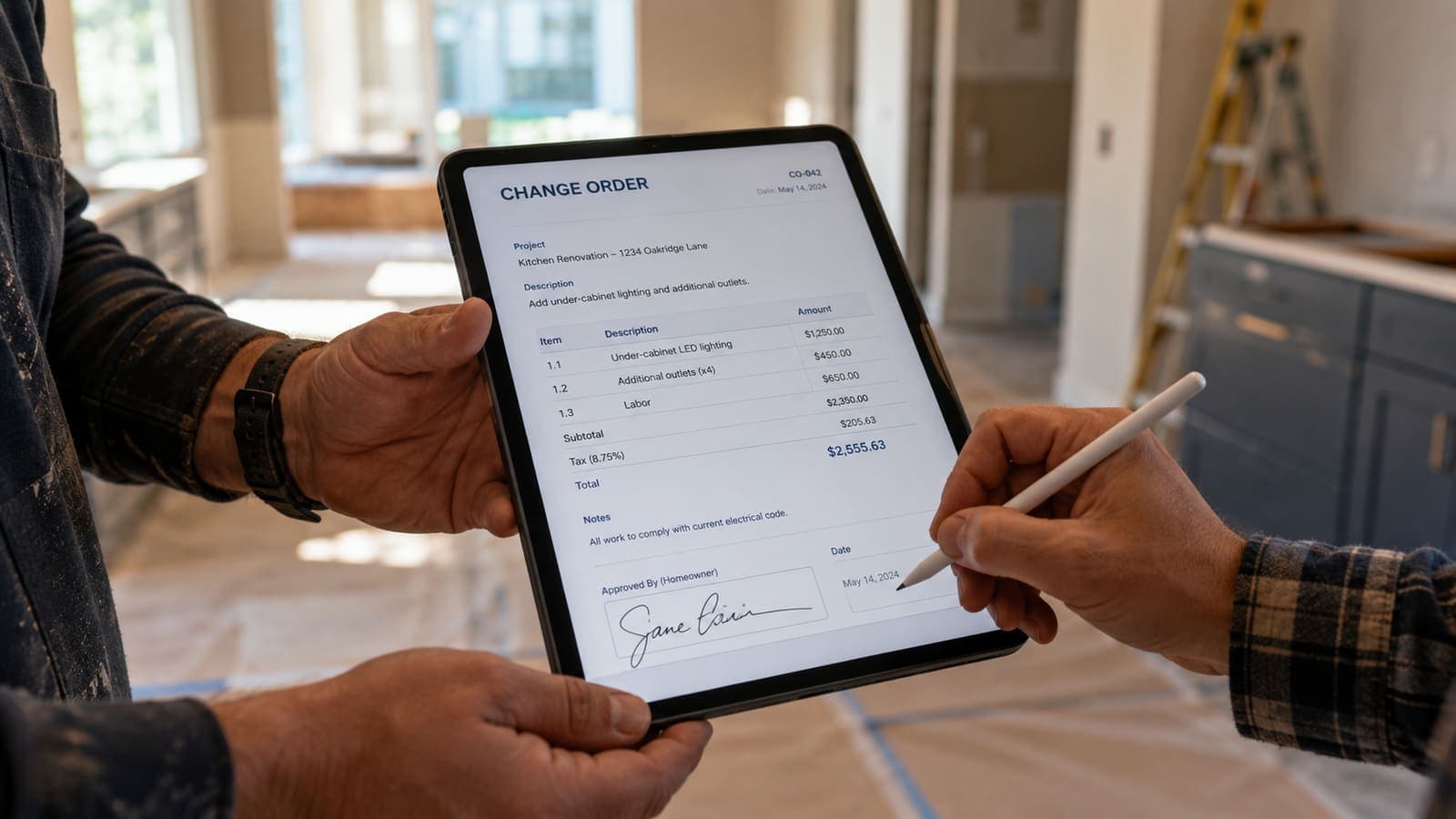
Approved change orders are added to the next progress invoice as their own lines, with the approval date. Do not hold them for the final — a change order that surfaces for the first time on the last invoice is the one that gets disputed, and by then the leverage is gone.
Make the schedule part of the estimate
The payment schedule belongs on the estimate the customer approves, not on a separate document later. When the approval covers the price and the schedule together, every invoice is just the schedule happening on time.
What progress billing is not
On commercial jobs, “progress billing” usually means a schedule of values billed by percentage complete on AIA G702/G703 forms, with retainage (typically 5–10%) held back until completion. Those are contract requirements set by the owner or GC, with their own paperwork. FieldsHub does not produce G702/G703 forms or track retainage; it handles deposits, milestone draws and final invoices as described here, which is what most residential and small-commercial jobs need. If your contracts require AIA billing, use a tool built for that paperwork alongside it.
On commercial jobs the architect will expect progress billing on AIA G702 with a G703 schedule of values — scheduled value, work completed previously and this period, retainage, balance to finish. Our free invoice template uses a simpler deposit, progress and final layout, so if a job needs G702/G703 you will fill those forms separately and keep FieldsHub for the cash side.
Sources
Ready to put this into practice?
Start a free FieldsHub trial — no credit card required.
Start Free Trial