How to Write a Construction Estimate: A Step-by-Step Guide for Small Contractors
From the site visit to the approval, the seven steps that produce an estimate you can defend — including how to price labor, set markup, and present it so it gets approved.
Most bad estimates are not bad at math. They are bad at scope — they price work the customer did not ask for, or leave out work the customer assumed. This guide walks the seven steps in the order experienced estimators actually do them, with the small-contractor shortcuts that keep it to an evening instead of a weekend.
1. Walk the site with a checklist, not a notepad
Photograph everything you will touch and everything next to it. Measure twice and write the measurements on the photo if your phone allows it. Ask the three questions that change the price most: what is behind this (walls, slab, ceiling), what has been done before (previous repairs, permits), and what does the customer want to decide later (selections). You are not pricing yet; you are collecting the facts the price depends on.
2. Write the scope before you price a single line
Three to eight sentences, plain English, ending with where your work stops. Writing the scope first forces the decisions that pricing hides: are you patching drywall or not, who pulls the permit, who hauls debris. Everything you decide here becomes a line item or an exclusion.
3. Do the takeoff
List quantities with units for every material and every labor task: 240 LF of 12-2 wire, 18 devices, 6 hours of trenching. For repeat work, keep assemblies — a “20 A circuit, EA” that already contains the wire, breaker, box and labor — and count assemblies instead of parts. Assemblies are how you get a takeoff done in twenty minutes.
4. Price materials at today’s cost, not last year’s
Pull current supplier pricing for the big-ticket lines (panel, fixtures, lumber, roofing) and use your assembly costs for the small stuff. Add a waste factor by material — 10% on sheet goods and tile, 5% on wire and pipe — and say so in the scope if the customer will see the quantity.
5. Price labor by the crew-day, then check it by the task
Decide how many crew-days the job takes and multiply by your fully loaded crew-day cost (wages, payroll taxes, insurance, the truck). Then sanity-check against task rates — if the task list says 3.5 days and your gut says 5, your gut is usually counting the things the task list forgot: setup, cleanup, the inspection wait, the trip to the supply house.
6. Add overhead and profit on purpose
Overhead is everything that keeps the lights on when nobody is on a job: insurance, software, phone, the office, your own unbillable time. Divide last year’s overhead by last year’s billable revenue and that percentage goes on every estimate before profit. Then profit on top — a number you chose, not a number left over. If you do not know your overhead percentage, that is the first spreadsheet to build.
Markup and margin are not the same number. A 25% markup on cost is a 20% margin on price. Decide which one you are using and put it in writing for yourself.
7. Present three options and ask for an approval, not a signature
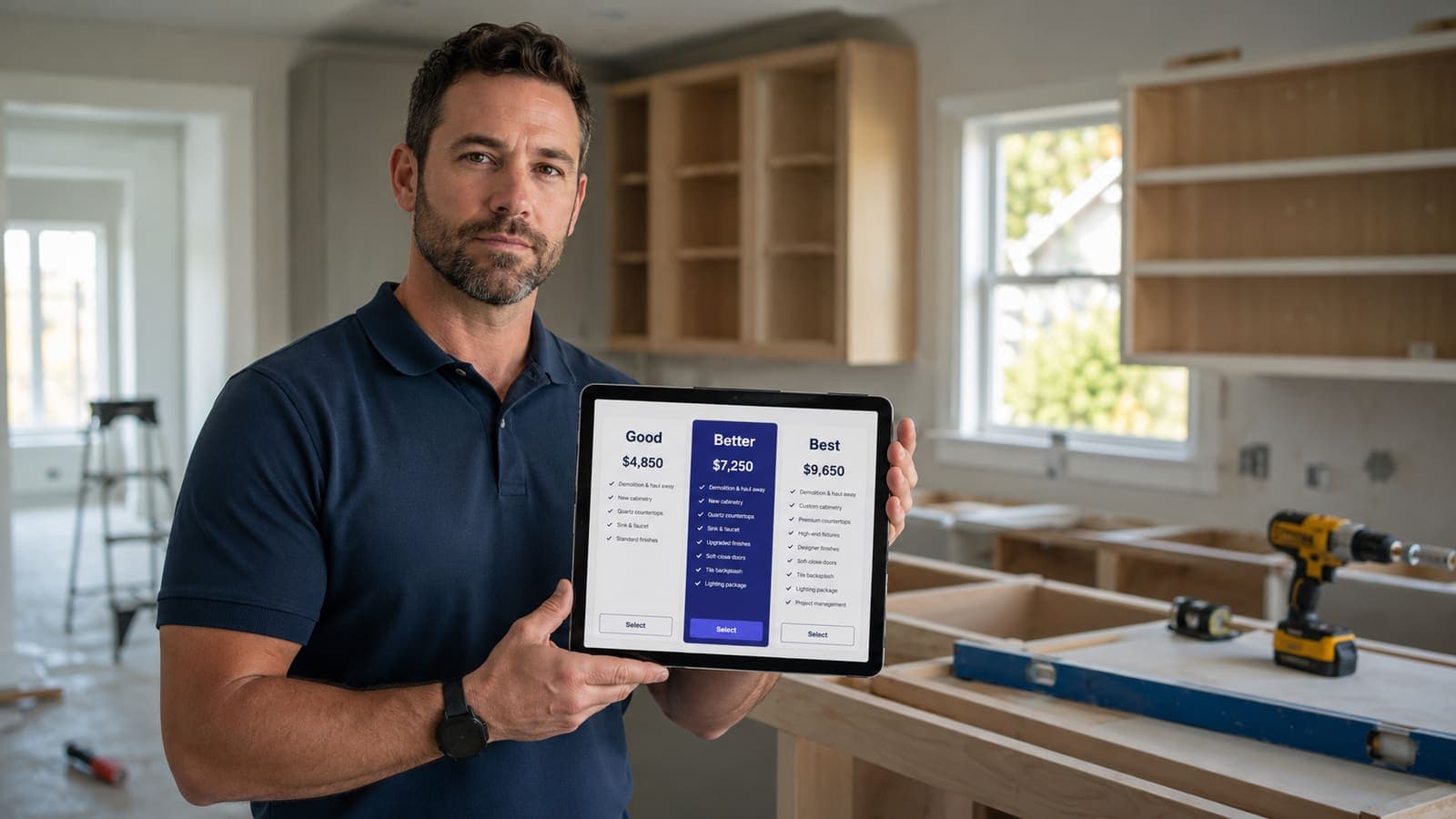
Where the job allows it, present Budget, Standard and Premium as three complete scopes. Send the estimate as a link, not a PDF, so the customer can approve it from their phone and you get a timestamp. Follow up on day three, not day ten. An estimate nobody opened is not a lost bid; it is an unsent one.
A worked example
A 200 A panel upgrade on a 1990s ranch. Scope: replace panel, meter base and mast; rewire existing circuits; utility coordination; drywall patch; painting by owner. Takeoff: panel assembly (1 EA), meter base and mast (1 EA), circuit reconnect (24 EA), permit (1 EA), drywall patch (1 EA). Materials at today’s supplier cost, 1.5 crew-days of labor, overhead at the shop’s rate, profit on top. Three tiers: Budget keeps the existing meter base where code allows; Standard is the full scope; Premium adds a whole-house surge protector and a generator interlock. The customer approves Standard on their phone the same evening.
If a general contractor or architect asks for your scope “by division”, they mean CSI MasterFormat — the standard numbering (Division 26 for electrical, 22 for plumbing, and so on) that commercial estimates are organized by.
Sources
Ready to put this into practice?
Start a free FieldsHub trial — no credit card required.
Start Free Trial